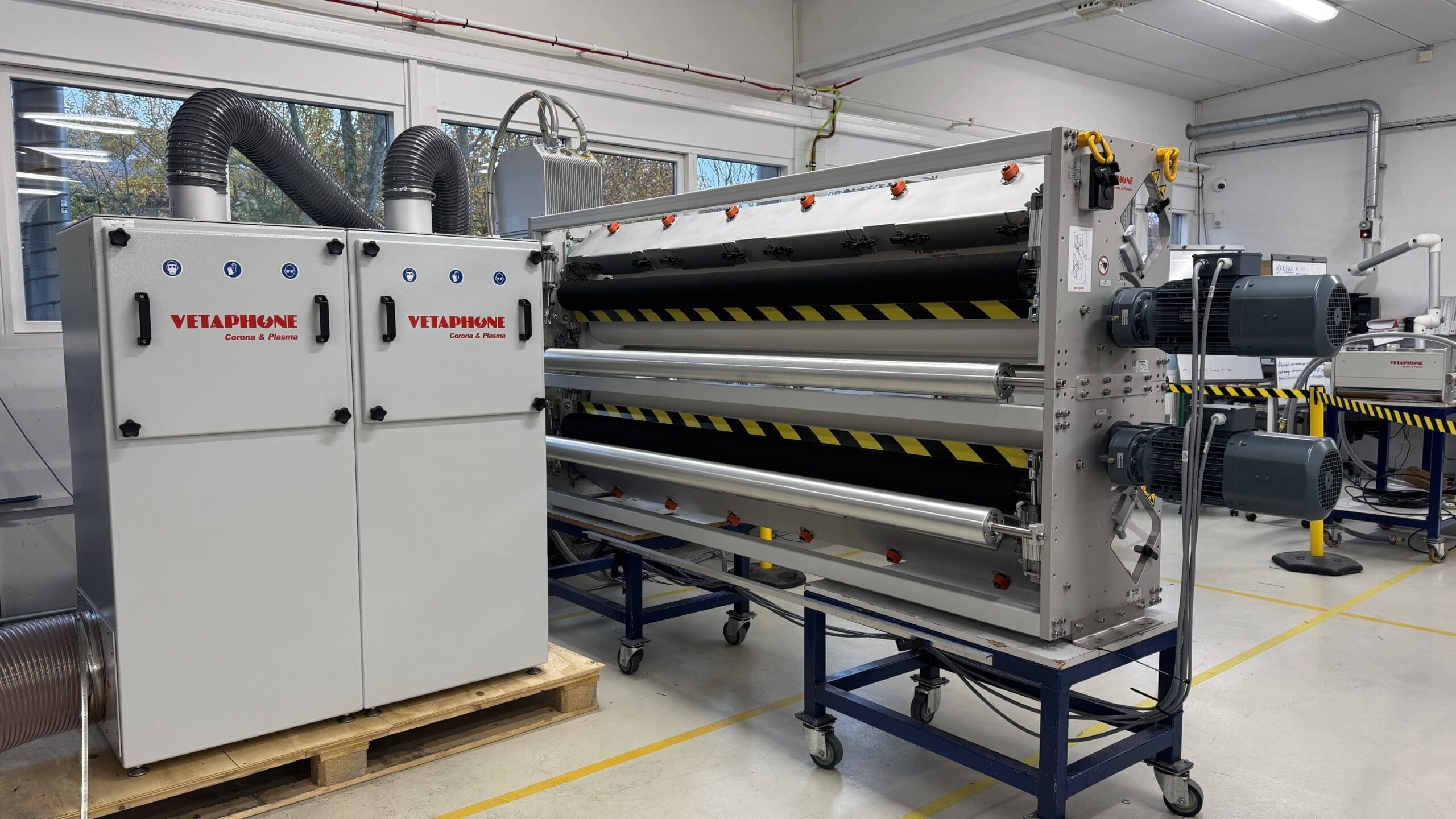
Has the time come to replace flame treatment with corona? Kevin McKell, Chief Sales Officer at Vetaphone, looks at current trends in the package printing sector considering the changing environmental scene and burgeoning energy costs.
The background
There is a clear trend in the packaging production sector that many companies are replacing traditional flame treatment with corona treatment on a variety of substrates, especially in the paper and board markets. While historically, flame has been the preferred surface treatment, the current shift in thinking has been brought about by a variety of factors, not least of which is the rapidly increasing cost of gas across developed markets.
But other factors are adding weight to the argument for change. Corona surface treatment has also been around for many years – in fact it was invented by us in the early 1950s, and we’ve pioneered its development in subsequent decades. Where flame has always been thought of as the shotgun approach for rough and rugged surface treatment, corona was always perceived as a more the finely targeted approach for more sensitive material. And, in the past, this held true.
So, what’s changed? In short, the quality of the paper and boards needing treatment and the capability of the latest corona technology. Modern manufacturing methods have significantly reduced the fibre and surface contamination from dust and oil in the production environment. This makes corona treatment a more than viable alternative, notwithstanding its energy cost-savings that are already being enjoyed by a growing number of converters.
Let’s be clear. The need for surface treatment, especially in the packaging industry, is a fundamental – no argument! The need to modify the surface structure of certain substrates to allow them to be converted into packaging items, especially in the food sector, is an accepted part of what is one of the largest global industries, and one that is projected to continue an upward trend for the foreseeable future.
The result of both flame and corona treatment is the same in that the surface of the substrate is modified to allow better adhesion of liquids such as inks, varnishes, and adhesives. This is achieved by breaking up the long molecular chains on the surface to allow oxygen to attach. This increases the surface energy (tension) of the substrate to match that of the liquid, which can then ‘wet-out’ – another way of saying it stops the liquid from ‘beading up’.
Is it just a cost issue?
So, if the two methods achieve the same, what’s the problem? This issue is that flame treatment comes at a price, and one that is not measured solely in monetary terms. In the case of many suppliers to the industry that price is carbon emissions and all that these imply in terms of the environment in which we live. It’s not a new issue but with obvious climate changes being seen worldwide, it is becoming a more prominent problem that needs addressing, and soon.
First of all, it’s important to understand exactly what are the terms of reference for carbon emissions. Current CO2 emissions average 6.6 tonnes per capita globally, or more than twice the levels of pre-industrial times, and in developed countries can be up to 10 times as high. Carbon dioxide (CO2) is the main culprit in what are generally known as Greenhouse Gas (GHG) emissions, and are created by burning fossil fuels like coal, oil, and gas.
Heat, industry, and transport are the major emitters, accounting for around 60% of the total. GHG emissions are responsible for global warming as they prevent heat from escaping into the atmosphere. Basically, the Sun emits short wave radiation (sunlight) that passes through the greenhouse gases to heat the Earth’s surface but in return the long wave radiation is absorbed and prevents the heat from dissipating.
What can be done about it?
In simple terms, stop burning fossil fuels. In practical terms, start reducing the levels of CO2 emitted and create a financial incentive to make it happen. Essentially, this is what carbon trading is all about and since the use of flame surface treatment in packaging production is a major contributor to GHG emissions, a switch to a ‘cleaner’ technology, like corona, can offer significant financial benefits – both from lower energy consumption at a time when costs are rising, and the ability to offset reduced carbon emissions by selling them to higher emitters.
Carbon emission trading seeks to put a cash value on the volume of carbon emitted by country thereby allowing them to meet their pledges under The Paris Agreement of 2016. As of 2023 there are 194 states, and the EU as one body, that have signed the Agreement, representing around 98% of total GHG emissions.
Emissions trading sets a quantitative total limit on the emissions produced by all participating emitters, which correspondingly determines the prices of emissions. Under emission trading, a polluter having more emissions than its quota must purchase the right to emit more from emitters with fewer emissions. This is seen as more effective than a fixed carbon tax because it allows greater flexibility. Each country defines its own emission trade allowance, and this varies from a low of around $7/tonne in Asia to around $63/tonne in the EU.
Emissions trading programmes such as the European Union Emissions Trading System (EU-ETS) complement the country-to-country trading stipulated in the Kyoto Protocol by allowing private trading of permits, coordinating with national emissions targets provided under the Protocol. Under such programmes, a national or international authority allocates permits to individual companies based on established criteria, with a view to meeting targets at the lowest overall economic cost.
Time to take action
With most brand owners and a growing number of consumers now very aware of the term ‘carbon footprint’ and what it means to the well-being of the planet and future generations, there is no time to lose. And this is where the situation also becomes of financial benefit to those switching to lower carbon emitting practices, such as using corona rather than flame surface treatment for the production of packaging. By reducing the gas consumption needed for flame treatment and consequently reducing the energy cost, while at the same time emitting less carbon into the atmosphere that allows you to trade your lower emission rating to a higher emitter, and banking the benefit in cash, production costs can be significantly reduced – and your environmental conscience salved!
Corona treatment is a patented, well-proven and globally accepted standard in the production of packaging using non-absorbent substrates. As a mature process of more than 70 years its efficiency and cost-effectiveness are well documented, and ongoing research ensures that it continues to maximise bonding strength on each of the new substrates that are continually being developed. Whatever your surface treatment needs, as the inventor of corona technology, we have unrivalled knowledge and expertise to resolve your problems.
Keen to know more? Drop us a message and we’ll come straight back to you!
