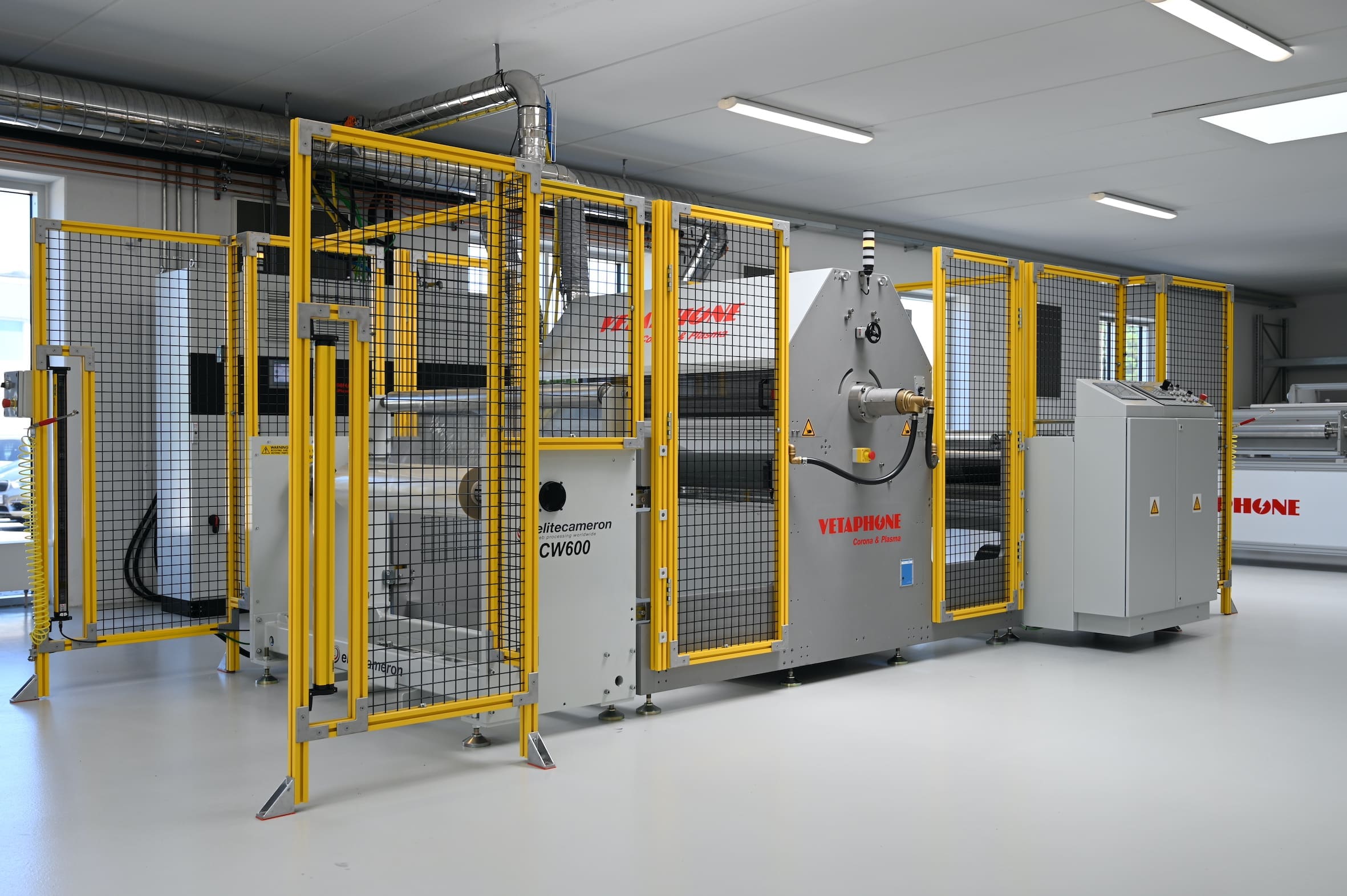
The use of water-based inks and adhesives on BOPP is currently limited, without the added use of an expensive primer. The reason is the limitation of the substrate’s ability to react with oxygen, resulting in a maximum obtainable surface tension of 46 dyn/cm, after corona treatment. The only solution today is to use BOPP that is already primed or has an inline primer for the purpose. This is expensive and the primer is solvent based, which affects the substrate thickness.
But, with Vetaphone’s Plasma technology, it’s possible to obtain up to 60 dynes on BOPP, with by far the industry’s lowest gas consumption. With such reduced running costs, an ROI of as little as 12 months has been tried and proven in a commercial environment.
To explain this, we need to look at the chemistry of the BOPP surface. Corona is an electrical discharge, typically ranging between 30kW and 40 kW. With this discharge, existing molecule chains are broken, and new ones are created. The new molecule chains on the surface are mainly created from the oxygen in the ‘air gap’ from the ambient atmosphere. The O2 molecules break into O-atoms, which then connect with the CH-based groups on the surface of the plastic film, creating the new molecule chains. The bi-product is Ozone (O3), which then is removed from the area by the mandatory exhaust on the Corona treater.
Plasma is like corona with the electrical discharge achieved in the same way. But, unlike Corona, which uses ambient air, Plasma works with a highly controlled atmosphere, which for this application is Nitrogen-based. By removing all the Oxygen, Plasma can graft specific molecule chains on top of the surface. When aiming for high dyne levels on BOPP, the desired molecule chains created are predominantly Amine, Amide, and Imide groups. But in addition, by removing Oxygen from the air-gap, there is no Ozone created. Creating the required molecule groups alone is not enough. The knowledge of how to treat the surface evenly to the same dyne level, with the lowest level of consumables, is key to making the best and cheapest product. The secret lies in how to create the correct mix of molecule groups on each specific material in a highly controlled atmosphere.
There is a limit to the level of oxidisation on the surface. After reaching 46 dyn/cm with Corona, merely increasing the power applied will not improve the surface tension further. However, with Plasma Standard Grafting, 56 dyn/cm is obtainable on BOPP material, and by using Advanced Grafting, Plasma treatment can obtain a surface tension of 60 dyn/cm. It’s worth noting that, just as with Corona, neither type of treatment benefits from increasing the power still further. There is a common perception that Plasma is merely advanced Corona. This is untrue because of the variables involved. For many materials, it is still possible to obtain significant surface adhesion from Corona, and for these materials changing to Plasma would give little benefit and significantly increase cost.
One great advantage of Plasma, and it does not need to be done inline, is coping with a condition known as ‘ageing’. After Corona treatment, the additives in the plastic film migrate back to the surface. With the molecular structure that Corona has created on the surface, this is quite easy. Depending on the amount of additives, this ageing effect can be measured from hours to weeks. The fact is, there is always dyne decay (ageing) until a substrate reaches its ‘native’ level, which for BOPP is 32 dyn/cm.
Corona treated BOPP decays back to its ‘native’ 32 dyn/cm in weeks. With Plasma Standard Grafting the rate is similar but from a higher start level to a higher finish level, around 46 dyn/cm after six months, where it stabilises. With the Plasma Advanced Grafting, there is no ageing at all. The achieved 60 dyn/cm on BOPP stays at that level even after 18 months. As is the case with Corona, when using different materials, you need a different power per square area, also known as the Material Factor, which is measured in Watt·min/m2, to reach the desired dyne level. This factor differs for each material, and even the same material from different suppliers can result in different Material Factor requirements, depending on the exact chemistry the producer is using to manufacture the product.
Uniquely for Plasma, it’s possible to change the Material Factor and the atmosphere, to create high and lasting dyne levels. By changing the gas-mix, which is predominantly Nitrogen-based, it is possible to tune the amount of the different molecule groups. The exact gas-mix is easily created in the Vetaphone laboratory, and all the gases needed are available from any supplier. The typical added running cost, compared with Corona, is between 0,30-0,50 ¢/m2. The gas consumption of a Vetaphone Plasma system is less than half that of any other system on the market today, and not only does the system consume less gas, but the gas is also royalty free, meaning it can be bought from whichever supplier the customer chooses.
To date, Vetaphone has obtained higher dyne levels with Plasma on PP, OPP, BOPP, PVC, PET, and PVDC. And we have obtained longer lasting dyne levels with Plasma on BOPP, Fluorinated Polymers (FEP, ETFE, ECTFE), PE, PLA, COC, and COP. This is just the beginning, because the recipe for many more materials will become available in the future as the Vetaphone chemists continue their R&D in the industry.
Plasma technology is not a new phenomenon, having been used in laboratories since the 1990s. The difference now, is that it has moved to commercial production machines. In the past, the main limitation was that the equipment could not accurately control the atmosphere. One solution was to increase the consumption of gas, which for small machines, low speeds, and short runs, proved partially successful. But the problem with this method was that it showed no return on investment, added to which the equipment was sold under contract, where the user had to buy gas from the machine supplier, often not at the open market price. This gave the technology manufacturers no incentive to make the systems more gas efficient. The other major problem was poor atmosphere control so that even with high gas consumption, the treatment was uneven and is the reason this type of equipment was never successful in a commercial production environment.
That’s all history now, because today’s Vetaphone Plasma technology offers a solution to these known problems. Not only is gas consumption significantly lower but the atmosphere is controlled throughout the entire production process, monitoring the influential factors and adjusting flow and gas mix accordingly. Today, as proof of quality, the customer can see logs of consumption, measurements of power, gas mix, and other deciding factors that ensure the atmosphere is accurately controlled, and the process is within specification. With no limitations on speed or width of treatment, Vetaphone Plasma now gives users the ability to see it work on small-scale laboratory machines, and in full size commercial production.
Enjoyed this? You may want to delve deeper into Corona vs Plasma – and we have a tech paper on this very subject, you can download it here.
